Nav:HOME ---- Travel Articles and Tips
Senoran Desert and wild Tucson (Tucson Arizona)(YOU ARE HERE)
WILD
TUCSON AND THE SENORAN DESERT
-
The name 'Tucson"
conjures up images of desolate desert and the city located in it.
But the Senoran Desert that surrounds Tucson is far from empty, though
for most of the year it is dry. As an angler, my first thoughts
were 'OK, how far to the nearest mountain stream?' About 1.5 hours.
While fishing was likely out, the desert offered its own rewards.
Not only did Tucson have immense opportunities for feasting (Chaco's near
Davis Monthan AFB for Senoran Mexican, Pinnacle Peak for Steaks), but the
city boasts an abundance of places to hike, bike, and climb the calories
off.
- The desert plays host to a strange schedule reversal from the natural rhythms
of most places. The summer is dry, the winter is less dry, the nights
are active, and the days are silent. A trip to Saguaro
National Park to see the large and old saguaro cactus during a summer
mid-day will quickly reveal why the desert is quiet in the day-IT IS HOT!
A warm summer day in the park will top out around 110-120 degrees Fahrenheit
with near no humidity. Any dark car interior will lead to first degree
burns for any skin that touches it, water bottles left in the sun will
burst, and water will evaporate swiftly from human skin. The desert
floor is hot enough to cook on. Nearly all animals are burrowed into
the ground or into the saguaro, mesquite, or thorny choya. The only
sounds are from the whistling wind, or from the occasional human.
Within an hour after sunset, however, the park is a different place.
Bats swoop to feast on the numerous insects, bird chirp, and roadrunners
pursue desert mice, while scorpions and tarantulas scurry about.
Bring LOTS OF WATER( one liter/person/hour at least), good hiking boots,
pants (to ward off the choya's), a wide-brimmed hat, sunscreen, and a camera.
- A Trip north of the National Park, will lead to a wetter version of the desert.
Thanks to a winding and sometimes nearly dry Sabino Creek, and to the city
of Tucson,
Sabino Canyon offers swimming (if the season is right), hiking, rock
climbing, and mountain biking. The city even offers trams to lift the travel
weary up through the canyon along the paved main trail along the creek.
For the more adventurous, several natural side trails wind along the creek
and through the canyon, which gradually climbs and narrows, terminating
in the national forest below Mount Lemmon. A sunset or evening trip
along the trail will expose you to cooler temperatures and lots of life.
Animals need water after a long days snooze and at sunset they travel to
the creek to find water. The hoots of owls and coyotes, the chirps
of night birds, crickets, and bats, and the splashes of
green sunfish in the creek liven the night. There is a cool breeze
that flows down the valley at night from the mountains, scented with creosote,
pine, cactus, and sage, making any night hike a wonderful conclusion to
any dinner.
- If the daytime heat and lack of true green get you down, an hour and a half
drive into the mountains will take you from a hot valley floor to cool,
pine covered, mountain vistas.
During the winter, snow blankets the areas above 6000 feet, but by late
spring even the ski area of Mount Lemmon lacks a snow coat. The
mountain offer hiking through the rough terrain, and the little chalet
town at of Summerhaven hosts beautiful views and good food (especially
spiced wine and soup at the mount lemmon lodge, and cookies in the
town). The mountain area also hosts alpine animals such as mule deer,
big horn sheep, chipmunks, ground squirrels, and bears. The Ranger
Station in the Coronado National Forest has maps and information on hiking
and biking trails (including the road up), and climbing areas (excellent
rock climbing!).
- If all that wasn't enough, Davis Monthan AFB
hosts the largest 'graveyard' (a.k.a. Boneyard) of aircraft in the western
hemisphere. Literally thousands of aircraft that have outlived their
usefulness are stored on the base for long-term storage, from F-83's to
B-52's, and 747's to F-16's. While a six-month lead time is needed
to get a tour of the Boneyard, a drive around the base will cover many
of the aircraft, and the Pima Air Museum will cover the rest. Interestingly,
thanks to lots of water onthe base and sandy soil, the base also hosts
a thriving population of burrowing owls (really
hard to get close to for a picture!)
- Tucson holds lots of things to do, and one could spend a lifetime exploring the
mysteries of the Senoran Desert, so have fun on your next trip there and
enjoy the heat!
Back to Top
- WHEN?
While the summer is very hot, the spring, fall, and winter hold milder
temperatures and an occasional rainstorm. I recommend the beginning of
the spring in march, when the desert blooms, though every season holds
its joys.
- HOW
DO I?
-
Hiking- First try Sabino Canyon. It is more
civilized with drinking fountains, paved trails, and rest rooms every quarter
mile. For the more advanced hiker, do Saguaro National Park, or the
shorter Coronado National Park Trails. For the really adventurous,
bring a pack, water, food, a compass, and a friend, and hike the desert
floor or the long hike from the bottom of Sabino Canyon to Summerhaven.
Always bring LOTS OF WATER and good boots, sunglasses, sunscreen, a map,
a compass, and a friend.
-
Mountain Biking- There are several mountain biking
expedition companies around Tucson, a quick glance at the yellow pages
will reveal many. For a less expensive alternative, rent a bike,
toss it in your car, and drive to Sabino Canyon during its posted biking
hours, or haul it to Saguaro National Park.
-
Skiing- Mount Lemmon in the winter is acceptable,
though you are really better off heading towards Phoenix.
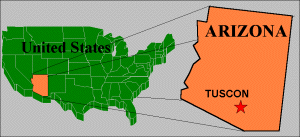
- WHERE AM I?
Tucson, Arizona
Back to Top
Latest Reports |
Fishing Articles |
Fishing Tactics |
Fish Ecology and Biology |
Travel Articles |
Fishy Fun |
External Links |
Shopping |
HOME
LEGAL: ALL content ©1993-2015 Bryce L. Meyer. The term "Combat-Fishing" is a federally registered trademark. "Combat Fishing" when used in reference to travel information, fishing websites, fishing or travel books, or similar products as a brand is also a trademark. Fish and Pole logo is also a trademark.